

Impact Update 2026
We’re on a mission to improve the lives of people, animals, and the planet through food. Our 2026 Impact Update shares select highlights of how we accomplished this through our business in 2025. For a comprehensive view of the company and our impact, please refer to last year’s full Impact Report.

Our impact strategy.
Our Impact Strategy focuses on ways we can positively impact our organization, stakeholders, and communities.
Transparency
Building a resilient food system
Bringing ethical food to the table in a way that benefits the environment and the animals throughout our supply chain
Accountabiilty
Fostering a people-first culture
Building trust with our crew, farmers, shareholders, communities, customers, and consumers
Standards
Driving engaged & accountable oversight
Establishing and upholding practices that underscore our dedication to ethics and transparency
Impact Goals
Making real progress on the issues that matter most
Our Impact Goals lay a clear path forward, balancing our commitment to long-term resilience with our determination for progress. While the goals outlined here focus on a three-year timeline, we continue to think ahead toward long-term opportunities to raise the standards even further.
Climate Change & Farmer Well-being
Mitigate climate risk in our supply chain and our farmers’ productivity. Goal: Engage 100% of farmers on regenerative practices by the end of 2026.
59% of 100% goal
Climate Change
Mitigate climate risk in our operations. Goal: Reduce operational greenhouse gas intensity by 25% by the end of 2027, compared to 2022.
–18.3% of –25% goal
Goal Achieved!
Crew Impact
Continue to build a more inclusive workplace for our crew. Goal: Increase favorability in our annual Inclusion Survey by 5% points by the end of 2023.
+7% of +5% goal
Goal Achieved!
Ethical Leadership & Governance
Ensure we maintain a high standard of ethics as we grow. Goal: Implement a formal, company-wide ethics training program and ensure completion by more than 95% of all crew members by the end of 2025.
99% of 95% goal
Ethical Culture
Engage and inspire our crew. Goal: Maintain more than 80% agreement that Vital Farms operates ethically and promotes an ethical culture in our crew engagement survey, by 2026.
In Progress
Materiality Matrix
Every three years, we conduct an assessment to identify the key Impact-related topics that matter most to our stakeholders and the success of our business. The results help us decide where to focus our Impact strategic planning efforts as an extension of our stakeholder model.
In 2024, we refreshed our 2021 Materiality Matrix to reflect our company’s growth, emerging issues, and updated stakeholder priorities. We took a double materiality approach to assess:
- How each topic presents risks or opportunities to our business
- How Vital Farms’ activities could impact our stakeholders for the given topic
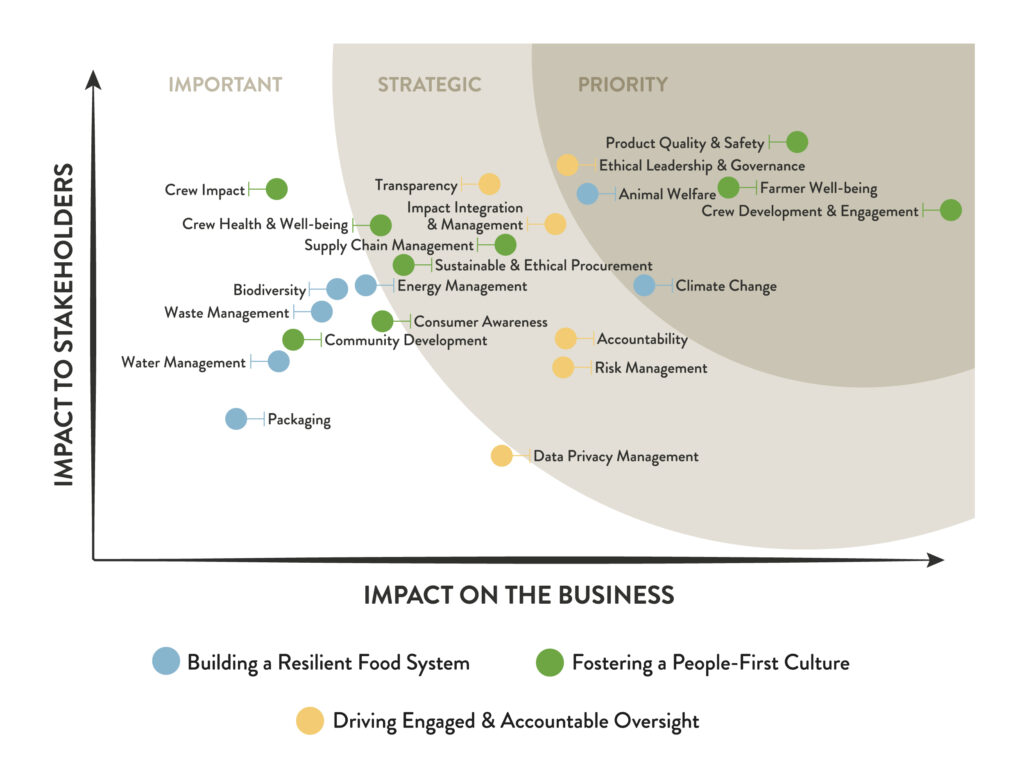
The topics on the updated Materiality Matrix were identified in collaboration with our internal and external stakeholders through a rigorous four-stage process:
Identification of Impactful Topics
A combination of our previous Materiality Matrix, industry benchmarking, and emerging issues determined the updated topics for our 2024 assessment.
Stakeholder Assessment
We engaged crew members, stockholders, consumers, and farmers to identify the ESG issues most impactful to them and our business.
Analysis and Action
We analyzed stakeholder, industry, and operational data to produce this matrix.
Validation
We reviewed the preliminary mapping and hierarchy of topics with key stakeholders to ensure consistency with our business needs.

Governance Structure
From the boardroom to the barn, we operate with a shared purpose: to improve the lives of people, animals, and the planet through food. Even in the highest level of leadership, we’ve embedded multiple layers of accountability and oversight to ensure our Impact Goals stay on track.
Board of Directors
Our Board of Directors and its committees oversee the company’s overall risk management strategy, including Impact and climate-related risks and opportunities. The Board receives quarterly reports from its Nominating and Governance Committee that include Impact progress along with annual reports from the company’s management-level Impact leadership. The Board also approves the company’s annual operating and capital budgets, which include operating expenses and capital investments related to climate change mitigation and other initiatives.
Nominating & Corporate Governance Committee
Oversight of Impact issues is managed by our Board’s Nominating and Corporate Governance Committee and is reflected in the committee’s charter. The committee oversees our strategy, initiatives, and reporting related to Impact, including progress towards our Impact goals. Its oversight function also includes responsibility for overseeing risk management with respect to Impact risk areas, including climate risk. Our Chief Legal Officer, Corporate Secretary & Head of Impact presents to the committee quarterly.
Senior Leadership Team (SLT)
Our SLT is the highest management level in our company. The SLT manages risks to our company, including environmental and climate-related risks, through regular reporting from several functional areas. The SLT includes our Chief Legal Officer, Corporate Secretary & Head of Impact, who reports directly to our Chief Executive Officer. The SLT manages our response to material Impact issues, including adverse weather events and other climate-related matters, and regularly reports out to the Board and its committees with respect to such risks.
Impact Team
Our Impact team reports to our Chief Legal Officer, Corporate Secretary & Head of Impact and works cross-functionally across our business to further embed sustainability in all that we do. The Impact team is directly accountable for the strategy, ownership, and implementation of Impact goals and initiatives, including measurement, monitoring, and reporting on progress to the SLT.
B Corp Certified
Vital Farms has been a Certified B Corporation since 2015. B Lab, an independent nonprofit entity who administers the B Corporation standards, assesses companies on more than 200 sustainability questions and awards B Corporation certification to companies that meet stringent social and environmental performance, accountability, and transparency standards.
To certify as a B Corp, companies must obtain a minimum score of 80 points on the B Corp Impact Assessment and undergo reevaluation every three years.
- Certified since
- 2015
- Most recently certified
- March 2025
- Overall score
- 98.6
- Community
- 20.0
- Workers
- 25.1
- Environment
- 32.7
- Governance
- 17.2
- Customers
- 3.2
Public Benefit Corporation
In 2017, we elected to be treated as a public benefit corporation under Delaware law. Public benefit corporations in Delaware are required to identify in their governing documents the specific public benefits that they will promote, and directors have a duty to consider these interests when managing the company. Our classification as a public benefit corporation underscores our commitment to our purpose and pursuit of long-term benefits for each of our stakeholders, including farmers and suppliers, consumers and customers, communities and the environment, crew members, and stockholders. The public benefits listed in our governing documents are:
Food & Joy
- Bringing ethically produced food to the table
- Bringing joy to our customers through products and services
People & Partners
- Allowing crew members to thrive in a fun and empowering environment
- Fostering lasting partnerships with our farms and suppliers
Business & Stewardship
- Forging an enduring and profitable business
- Being stewards of our animals, land, air, and water while supporting our community

View Past Impact Reports
2022 Task Force On Climate-Related Financial Disclosures (TCFD)